Artificial intelligence seems to be everywhere right now. Every week there’s another company telling us how AI is transforming the way they work, and as a brand, you might be wondering where that leaves you. Should you be talking about AI? Should you be building it into your products and services? Should it be front and centre in your marketing? Will it help you stand out from competitors? Those are important questions, but they may not be the most important ones.
AI is also changing how people discover brands and make buying decisions. Increasingly, potential customers can ask an AI tool to summarise a company’s reputation, compare providers or recommend who they should trust.
So perhaps the better question is this: if AI is helping people decide who to trust, how do brands earn that trust in the first place?
Let’s look at what the research says.
Table of Contents
1. Trust is becoming the main competitive advantage
When great content was expensive to create, brands had to fight for attention by creating top quality content, oftentimes based on – or accompanied by – desk research. Reach and visibility were key, as most lead conversions would be driven by these efforts. Today, AI can generate huge volumes of content cheaply, meaning content is everywhere and can be produced without much effort or adequate desk research. As a result, attention is no longer the scarce resource, but credibility is – more so than ever. This creates a challenge for AI systems and audiences alike. If every brand can publish content on the same topics, how do they decide which companies are worth recommending or engaging with? If many brands are leveraging AI-produced content effectively, which ones deserve the attention, the respect, and the investment?
For AI platforms, rather than relying solely on keywords, they look for numerous signals which indicate credibility, as well as specific markup like the Open Knowledge Format. Brand trust signals can include mentions in respected publications (for this, digital PR is the right approach), independent reviews (web directories listings, including Google Business and the atypical client review on their own website and social media), thought leadership, social media marketing (especially platforms like Reddit and Threads) and other forms of third-party validation. AI also learns from the wider web, rather than just your company’s website. External signals such as news articles, reviews and industry directories help inform its understanding of your brand. The more credible the sources that mention your company positively, the more confidence AI has in describing and recommending it.
Historically, trust helped customers choose between brands. Gartner argues that AI is making trust a factor in brand discovery too, influencing which companies are surfaced and recommended in the first place.

2. Buyers are becoming more sceptical
Gartner’s research found that trust in big brands among UK consumers fell from 70% in 2021 to 60% in 2025. While there are many factors behind that decline, it’s happening at the same time as AI is making it easier than ever to create content. Consumers have spent years becoming more cautious about advertising and branded messaging, but with AI, now almost anyone can now create large volumes of polished, professional-looking content that may not necessarily promoting the best service or product, from the consumer’s point of view.
As a result, buyers are placing greater emphasis on signals which sit outside a brand’s own marketing. Reviews, recommendations, media coverage, industry recognition and customer experiences can all provide reassurance that an organisation is trustworthy.
In other words, people are looking beyond what brands say about themselves and paying closer attention to what others say about them.
Research suggests consumers are also becoming more discerning, but not that they’re necessarily anti-AI. They’re willing to embrace it when it delivers genuine value, but they need evidence that it’s accurate and supported by real expertise.
3. AI search is reducing website traffic
Historically, a buyer might search Google for their problem and visit several websites to gradually build a picture of different providers. According to SparkToro, however, 68% of Google searches in the first four months of 2026 ended without a click to a website. The customer journey has changed, and looks set to continue changing as users find the information they need directly within search results, AI Overviews and conversational AI tools.
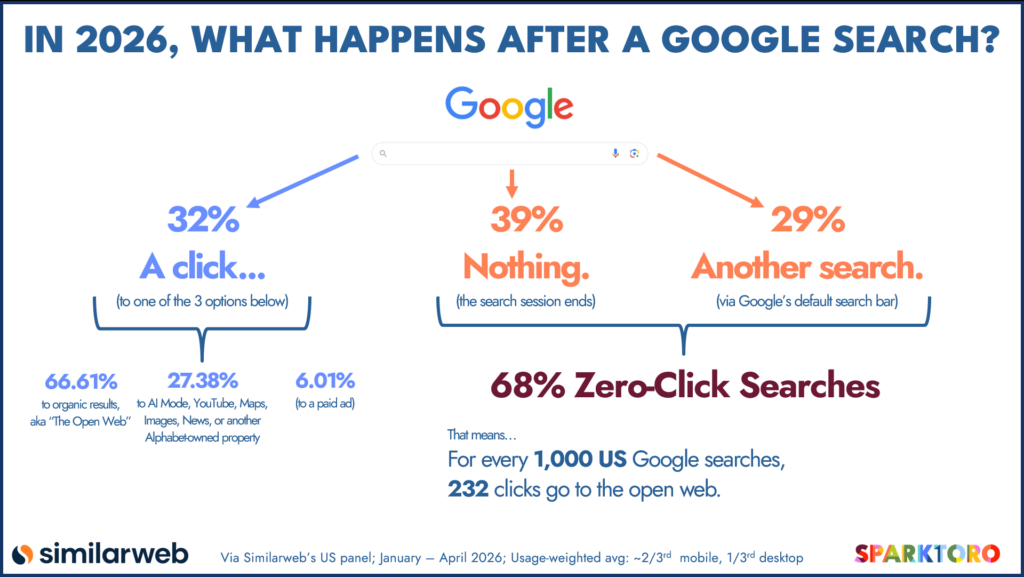
SparkToro notes that more than 20% of Americans now use an AI tool at least 10 times per month, while platforms such as YouTube, Instagram and TikTok are also being used as search engines in their own right.
For PR and communications teams, this means the focus is to be visible wherever an audience spends time – and that could be anywhere from industry publications, social platforms, podcasts or newsletters.
4. AI can damage trust if used badly
It’s widely known that AI can get facts wrong or “hallucinate” information, but as AI-generated content becomes more common, customers are becoming better at distinguishing between content created with human expertise, and content that has been churned out by a machine.
Over-reliance on AI-generated content can create the impression that a company is over prioritising efficiency. Even if the content is technically accurate, it may lack perspective and nuance. Ultimately that shortcut creates a breach of trust.
At the same time, buyers are becoming more diligent about validating AI information. Research from TrustRadius found that 90% of buyers click through to sources cited in Google’s AI Overviews to fact-check, while 77% consult user reviews and more than half speak to another user before making a purchase decision.
So what does all of this mean for your communications strategy? In many ways, it comes back to the same themes we’ve explored throughout this article. Audiences are still looking for human proof before making important decisions, which means building trust through external validation, customer advocacy and genuine expertise.
The practical takeaway
For brands, this is a reminder to invest in the activities which build trust beyond your own channels. Thought leadership, digital PR, expert commentary and customer advocacy all help create the proof buyers are looking for when evaluating a company.
As it happens, they’re also the same trust signals AI systems rely on when surfacing and recommending brands.
The way people find brands may be changing, but the reasons they trust them are remarkably familiar. Trust is as old as time.
If you’re wondering where to start, that’s exactly where Sapience can help. We work with brands to build the credibility, visibility and third-party validation which influence both buying decisions and brand discovery.
Do you want to learn more about building brand trust in an AI world?